ITALY
Rome
Eighteen stops through three millennia — from the Colosseum at dawn to a Trastevere wine bar after dark.
The walking day
18 stops in order
- 01

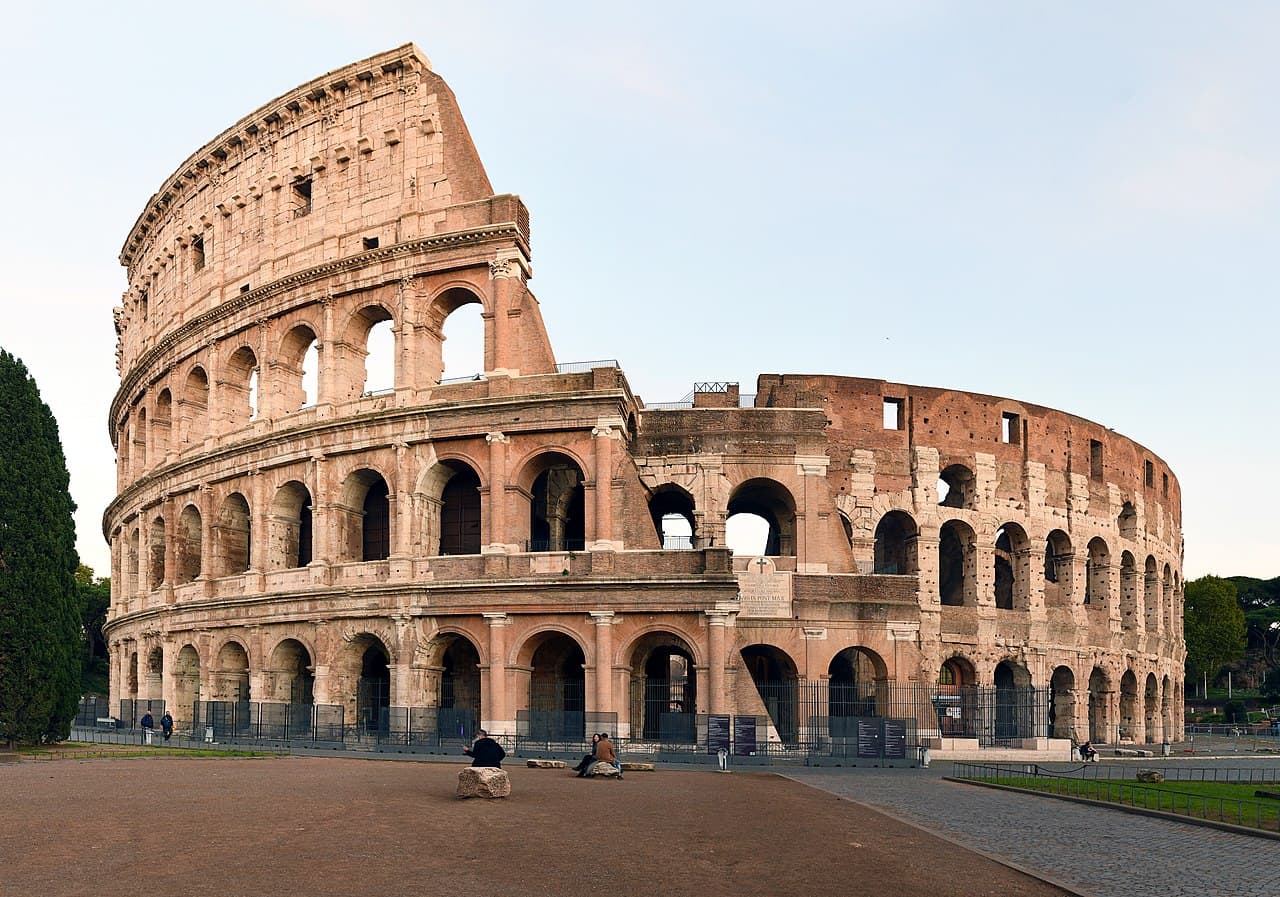
Colosseum
The Colosseum is an elliptical amphitheatre in the centre of the city of Rome, Italy, just east of the Roman Forum. It is the largest ancient amphitheatre ever built, and is the largest standing amphitheatre in the world. Construction began under the Emperor Vespasian in 72 and was completed in AD 80 under his successo…
- 02

Pantheon, Rome
The Pantheon is an ancient temple in Rome, Italy, originally built under emperor Augustus and reconstructed under Hadrian (117–138); since AD 609, it is a Catholic church called the Basilica of St. Mary and the Martyrs. It is perhaps the most famous, and architecturally most influential, rotunda.
- 03

St. Peter's Basilica
The Papal Basilica of Saint Peter in the Vatican, or simply St. Peter's Basilica, is a church of the Italian Renaissance located in Vatican City, an independent microstate enclaved within the city of Rome, Italy. It was initially planned in the 15th century by Pope Nicholas V and then Pope Julius II to replace the agei…
- 04

Swiss Guard
The Pontifical Swiss Guard, also known as the Papal Swiss Guard or simply Swiss Guard, is an armed force, guard of honour, and protective security unit, maintained by the Holy See to protect the Pope and the Apostolic Palace within the territory of the Vatican City State. Established in 1506 under Pope Julius II, it is…
- 05

Castel Sant'Angelo
Castel Sant'Angelo, also known as Mausoleum of Hadrian, is a towering rotunda in Parco Adriano, Rome, Italy. It was initially commissioned by the Roman Emperor Hadrian as a mausoleum for himself and his family. The popes later used the building as a fortress and castle dedicated to Saint Michael the Archangel, and it i…
- 06

Circus Maximus
The Circus Maximus is an ancient Roman chariot-racing stadium and mass entertainment venue in Rome, Italy. In the valley between the Aventine and Palatine hills, it was the first and largest stadium in ancient Rome and its later Empire. It measured 621 m (2,037 ft) in length and 118 m (387 ft) in width and could accomm…
- 07

Archbasilica of Saint John Lateran
The Archbasilica of Saint John Lateran, commonly known as the Lateran Basilica or Saint John Lateran, is the Catholic cathedral of the Diocese of Rome in the city of Rome, Italy. It serves as the seat of the bishop of Rome and head of the worldwide Catholic Church: the pope. The only "archbasilica" in the world, it lie…
- 08

Roman Forum
The Roman Forum, also known by its Latin name Forum Romanum, is a rectangular forum (plaza) surrounded by the ruins of several important ancient government buildings at the centre of the city of Rome. Citizens of the ancient city referred to this space, originally a marketplace, as the Forum Magnum, or simply the Forum…
- 09

Santa Maria Maggiore
The Papal Basilica of Saint Mary the Great, also informally known as the Basilica of Saint Mary Major, is a Roman Catholic Papal Basilica and one of the Seven Pilgrim Churches of Rome. The largest Marian church in Rome, it is regarded as the first Marian sanctuary and the mother of all Marian shrines. The shrine is ded…
- 10
Scala Sancta
The Scala Sancta are a set of 28 white marble steps located in an edifice on extraterritorial property of the Holy See in Rome, Italy proximate to the Archbasilica of Saint John in Laterano. Officially, the edifice is titled the Pontifical Sanctuary of the Holy Stairs, and incorporates part of the old Papal Lateran Pal…
- 11

Palatine Hill
The Palatine Hill, which is the centremost of the seven hills of Rome, is one of the most ancient parts of the city; it has been called "the first nucleus of the Roman Empire". The site is now mainly a large open-air museum and the Palatine Museum houses many finds from the excavations here and from other ancient Itali…
- 12

Stadio Olimpico
Stadio Olimpico, colloquially known as l'Olimpico, is an Italian multi-purpose sports venue located in Rome. Seating over 70,000 spectators, it is the largest sports facility in Rome and the second-largest in Italy, after Milan's San Siro. It formerly had a capacity of over 100,000 people, and was also called Stadio de…
- 13

Basilica of Saint Paul Outside the Walls
The Papal Basilica of Saint Paul Outside the Walls is one of Rome's four major papal basilicas, along with the basilicas of Saint John in the Lateran, Saint Peter's, and Saint Mary Major, as well as one of the city's Seven Pilgrim Churches. The basilica is the conventual church of the adjacent Benedictine abbey. It lie…
- 14

Arch of Titus
The Arch of Titus is a 1st-century AD honorific arch, located on the Via Sacra, Rome, just to the south-east of the Roman Forum. It was constructed in c. 81 AD by Emperor Domitian shortly after the death of his older brother Titus to commemorate Titus's official deification or consecratio and the victory of Titus toget…
- 15

Arch of Constantine
The Arch of Constantine is a triumphal arch in Rome dedicated to the emperor Constantine the Great. The arch was commissioned by the Roman Senate to commemorate Constantine's victory over Maxentius at the Battle of the Milvian Bridge in AD 312. Situated between the Colosseum and the Palatine Hill, the arch spans the Vi…
- 16

Mausoleum of Augustus
The Mausoleum of Augustus is a large tomb built by the Roman emperor Augustus in 28 BC on the Campus Martius in Rome, Italy. The mausoleum is located on the Piazza Augusto Imperatore, near the corner with Via di Ripetta as it runs along the Tiber. The grounds cover an area equivalent to a few city blocks nestled betwee…
- 17

Baths of Caracalla
The Baths of Caracalla in Rome, Italy, were the city's second largest Roman public bath complex, or thermae, after the Baths of Diocletian. The baths were likely built between AD 212 and 216/217, during the reigns of emperors Septimius Severus and Caracalla. They were in operation until the 530s and then fell into disu…
- 18

Capitoline Hill
The Capitolium or Capitoline Hill, between the Forum and the Campus Martius, is one of the Seven Hills of Rome.
Walk Rome today
Get turn-by-turn directions for this exact route.
The Travelhour app stitches every stop above into one optimised walking day, with arrival alerts and ticket booking inline.
ITALY
Rome
More cities